Put your hand up if you've been told that getting older means slowing down. Take it easy. Be gentle. Don't overdo it.
Not exactly true. And definitely not the whole story.
Midlife isn't a slowdown. It's a different (nuanced) game. As our hormones fluctuate and decline, two things are true at the same time: we need to listen to our bodies and recover more than ever, and our bones need more load than ever. Both. Not one or the other.
Because your bones? They don't want gentle. They want load.
Let's be clear: walking is amazing. Your heart loves it. Your metabolism loves it. Your mood? Obsessed. But it's not what builds our power, our strength or our bones. So what does? And how much do you actually need? Let's get into it.
When Bone Loss Actually Starts
Here's the part nobody told us: it doesn't necessarily wait for menopause.
In a big US study that followed women through the transition, bone loss started about a year before the final period, and it was fastest from then until about two years after (SWAN). Over ten years, women lost about 10% of the bone density in their spine on average, and most of it went in that window.
And some women lose more: up to 20% of their bone density in the five to seven years after menopause (Bone Health & Osteoporosis Foundation).
And perimenopause itself can start earlier than you think. In a 2025 study of more than 4,400 U.S. women, over half of those aged 30 to 35 already reported moderate to severe symptoms (npj Women's Health).
Oh, and one more thing: your timeline is yours. Things like smoking and a history of heart disease are linked to an earlier menopause (SWAN, 2001). And some women lose bone faster than others through the transition, including Chinese and Japanese women in the same big study (SWAN, 2012). Which makes right now a pretty great time to start.
What Bone Actually Responds To
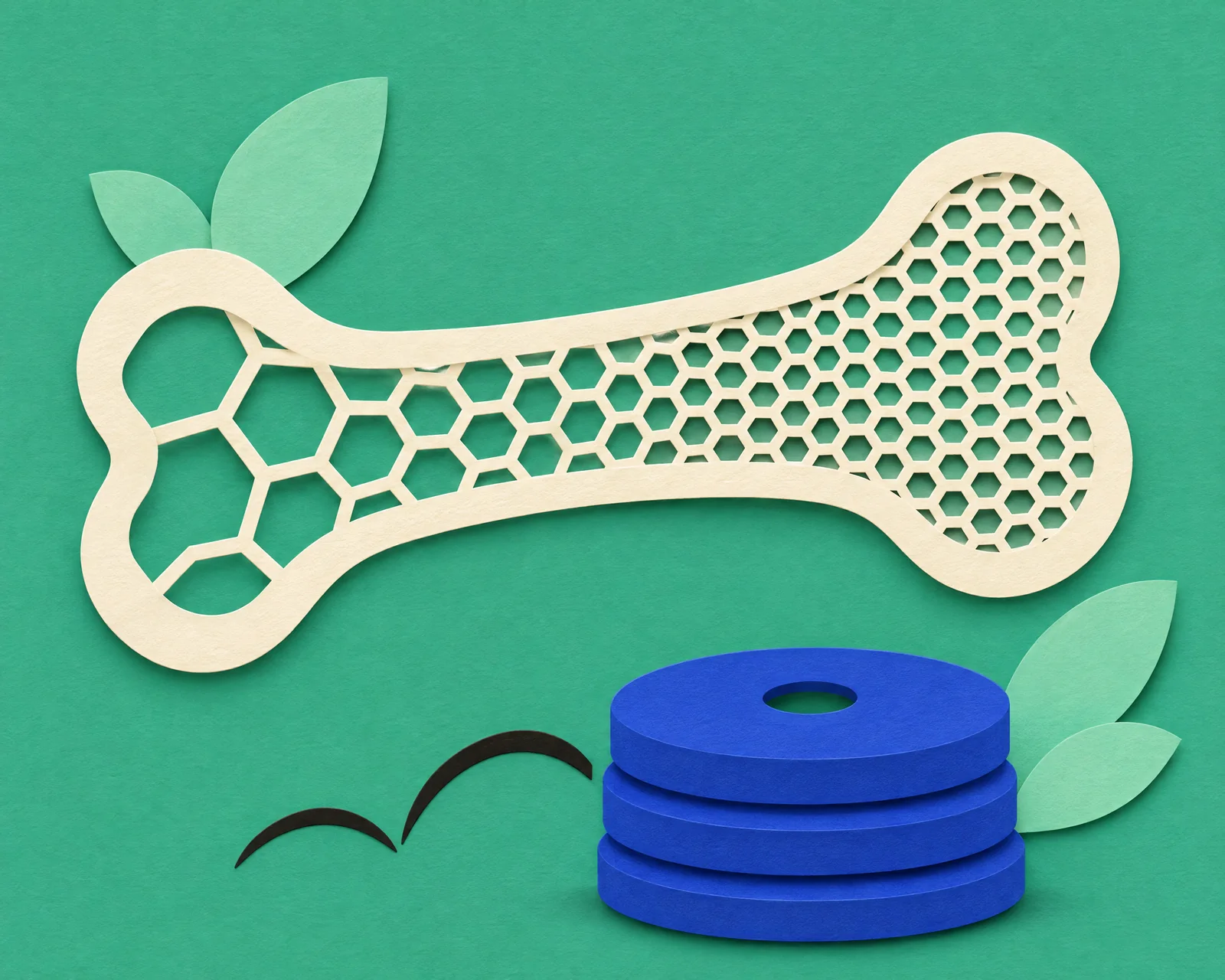
Bone is alive. It rebuilds itself based on what you ask of it. Bone researchers boil it down to three rules (Bone, 1998):
- It has to move. Bone responds to dynamic loading, like lifting and landing, not to holding still.
- A little goes a long way. A short burst of the right loading is enough to start the response.
- It gets bored. Bone responds best to loads it isn't used to: new moves, new directions, new challenges. So keep it guessing.
Your walks? Still amazing. They're a type of load for your hips and legs too, plus your heart, metabolism and mood are big fans. But here's the thing: bone gets stronger where you load it, and it gets most excited by loads that are heavy, powerful or new. So to reach the rest of your skeleton, it needs more from you. Heavier lifts. A little impact. Some variety in how you move.
So How Much Exercise Builds Bone?
Here's the honest answer: exercise works, and the program matters just as much as the minutes.
A review of 75 studies and 5,300 postmenopausal women found exercise does improve bone density at the spine and hip. The average effect was modest, and the authors pointed to a big reason why: many of the programs weren't challenging enough to give bone a real reason to change (Frontiers in Physiology, 2020).
When the program is right, it shows. In the LIFTMOR trial, postmenopausal women with low bone density did 30 minutes of supervised heavy lifting and impact work, twice a week, for 8 months. Their spine bone density went up 2.9%, while the low-intensity group's went down 1.2% (LIFTMOR).
So what does "right" look like?
- Heavy. A weight that's genuinely hard for 4 to 10 reps, repeated for a few sets. That's where bone pays attention (more on lifting heavy). And no, we're not saying ditch your 20-rep days. Keep them! They're just doing a different job.
- Impact. Big, powerful jumps and hops. Short, sharp moments your bones actually notice (Bone, 1998).
- Varied. New moves and new directions, so your bones keep getting a fresh signal. (Remember: they get bored.)
- Consistent. Twice a week, every week, for months. Bone takes its sweet time. In LIFTMOR, every 30-minute session mixed heavy lifts with impact, and the trial ran a full eight months before it measured (LIFTMOR).
And mixing it up pays off. A review of 11 trials found that programs combining different types of exercise improved bone density at the spine and hip in postmenopausal women (JOSPT, 2017).
Can't Jump? You Still Have Options
Leaking, sore joints, or a bone density result that makes impact feel scary? Fair. Here's the thing: you don't have to start with jumps.
- Lift first. Heavy, progressive strength work gives your bones a loading signal too.
- Build impact slowly. Heel drops before hops. Hops before jumps.
- Train your balance. It protects you from what breaks most bones: the fall.
If you have osteoporosis or a past fracture, talk to your doctor or a physio first, and get help with your form. LIFTMOR was closely supervised, and that matters (LIFTMOR).
Strong Bones Are Half of It
Quick game: picture your bestie, then look in the mirror. Bestie, mirror, bestie, mirror.
About one in two women over 50 will break a bone because of osteoporosis (Bone Health & Osteoporosis Foundation).
Sorry, that was mean. We know. But it gets the point across. Now let's change that stat together.
Strong bones are half of the answer. Not falling is the other half. At least a third of people over 65 fall every year. In a review of 108 trials, exercise cut the rate of falls by 23% (Cochrane, 2019). That's why we train balance, fast footwork and power in addition to heavy lifting every week.
How We Do It in 432
Every week of 432 has bone in it. Heavy, low-rep lifts with real rest between sets. Jumps that load your bones. And balance, footwork and power work that keeps you on your feet.
And when you repeat a workout, you go heavier. Because bone gets bored, it needs a bigger (or different) signal to keep adapting.
Bottom line? Don't let your bones get bored. Go text your bestie. Better yet, grab them for a workout. Lift heavy, jump big, mix it up, side by side. And then let's start rewriting that terrifying 50% stat for all of us, right now!
Everyone treats the symptoms. Nobody trains the systems. We do.
Your bones are listening. Give them something worth answering.
Stay strong with us.